THE ACTUARIAL BLOCKADE
Iran did not close the Strait of Hormuz. The City of London did

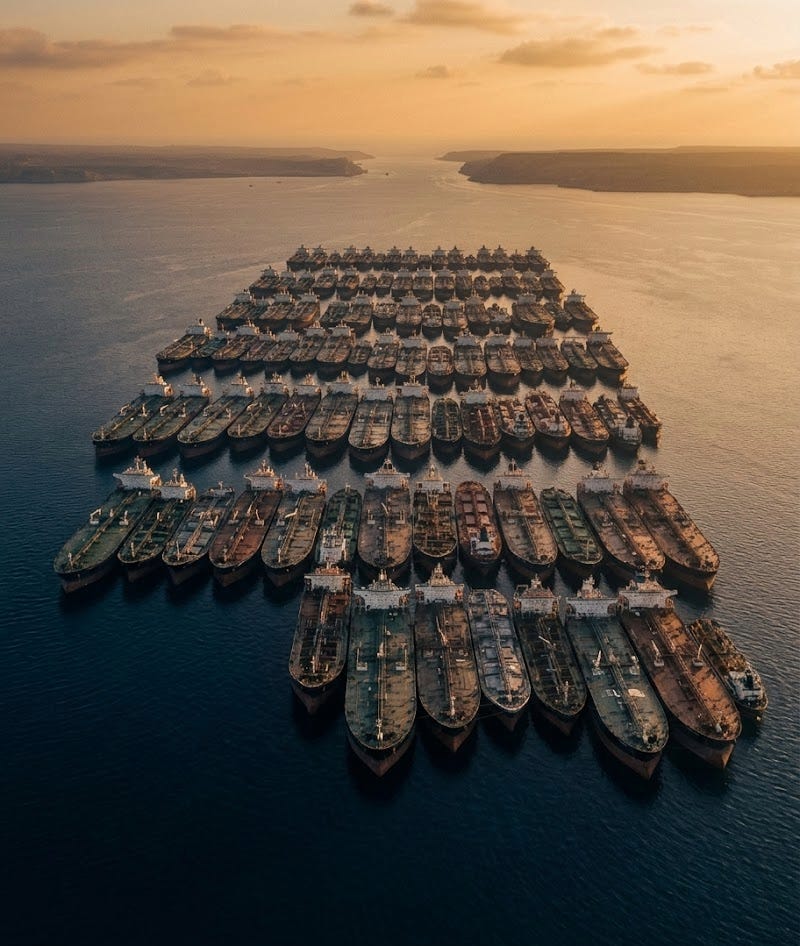
On March 5, 2026, the Strait of Hormuz closed. Not because Iran sank a fleet. Not because the IRGC laid an impenetrable minefield. Not because US naval escorts failed. The strait closed because, at midnight on March 5, war risk insurance policies for vessels entering the Persian Gulf became void — and without insurance, the global merchant fleet does not move.
The International Group of P&I Clubs — a mutual risk pool covering 90 percent of the world’s ocean-going tonnage — issued 72-hour cancellation notices on March 2. All twelve members. Simultaneously. Gard, Skuld, NorthStandard, the London P&I Club, the American Club, Steamship Mutual. By March 5, coverage had evaporated. The result was visible on maritime tracking screens within hours: more than 150 tankers idling outside the chokepoint, waiting for insurance that no longer existed in the private market.
The Strait of Hormuz is not closed by force. It is closed by spreadsheet. Those are two fundamentally different blockades operating on two fundamentally different logics.
This distinction is not semantic. A military blockade ends when the military operation ends. An actuarial blockade ends when the insurance market decides it has ended. Iran fired enough missiles to make the threat credible. The City of London did the rest. As Munro Anderson of Vessel Protect put it: the market was facing “a de facto close of the Strait of Hormuz, based primarily around perception of threat rather than a tangible blockade.”
This essay is about what that means. Not just for shipping. For the architecture of global power.
THE 72-HOUR COLLAPSE
A modern commercial ship is not merely a physical hull. It is a bundle of contractual obligations. Without war risk coverage, lenders withdraw financing. Charterers refuse to authorise voyages. Flag states revoke certificates of seaworthiness. The ship does not move - not because anyone ordered it to stay, but because the legal and financial infrastructure that makes commerce possible has dissolved beneath it.
This is what happened to the Strait of Hormuz between March 2 and March 5. The mechanism was not new. What was new was its speed and totality. Transit volumes collapsed 81 percent from approximately 138 vessels per day to 28. At least 40 Very Large Crude Carriers - each carrying roughly 2 million barrels of oil - sat idle inside the Gulf. Thirteen empty LNG tankers diverted away from Hormuz entirely. Oil prices hit $119 per barrel. VLCC daily charter rates, which had stood at $45,000 before the crisis, reached $432,000 during the actuarial closure phase - and then $538,000 when India’s Reliance Industries chartered a single vessel through the chaos, and $770,000 for a second.
The Joint War Committee - the London-based body that defines the geography of uninsurability - issued Circular JWLA-033 on March 3, expanding designated high-risk listed areas to include the territorial waters of Bahrain, Djibouti, Kuwait, Oman, and Qatar. War risk premiums for Gulf transit jumped from 0.05–0.2 percent of hull value to 1.5–3.0 percent for a single seven-day trip. For a tanker worth $100 million, a voyage that previously cost $200,000 to insure now cost $1 million to $3 million. For vessels linked to US, UK, or Israeli interests, underwriters tripled those rates again.
For most operators, the cost of insurance alone exceeded the potential profit of the voyage. The strait was financially closed before a single Iranian mine was laid.
WHY LLOYD’S BLINKED
Lloyd’s of London built its commercial reputation on precisely the opposite of what happened in March 2026. Lloyd’s insured convoys during both world wars, kept tankers moving during the 1980s Tanker War even when Iraq was bombing Kharg Island, and has historically priced danger rather than abandoned it. The institutional identity of Lime Street rests on the proposition that risk can always be quantified, and that there is always a premium at which coverage is worth writing. March 2026 tested that proposition and found it conditional.
The reason is structural, and it pre-dates the Iran war by years. Two years of Houthi attacks in the Red Sea had already depleted the reinsurance capital that underpins primary P&I clubs — the layer of “insurance for insurers” that allows the market to absorb catastrophic losses without individual club insolvency. By February 2026, that buffer was thin.
When hostilities escalated, the modelled loss probabilities for the region spiked to levels that triggered the Solvency II regulatory framework - the European capital standard that requires insurers to maintain liquid assets against potential catastrophic losses. The Persian Gulf contained an estimated $350 billion in vessel and cargo value within missile range of Iranian coastal batteries. A single day of IRGC strikes, if targeting the concentrated cluster of tankers outside Hormuz, could have produced losses exceeding the entire remaining reinsurance capital of the London market. The math was not a policy choice. It was a regulatory constraint.
When risk cannot be modelled, it cannot be priced. When it cannot be priced, cover is withdrawn. The underwriters did not panic. They calculated - and the calculation told them to leave.
There was a further compounding factor. GPS jamming and AIS interference affected over 1,100 vessels during the first week of the war. When vessels cannot confirm their own position, insurers cannot model their exposure. Underwriting requires information. The IRGC’s electronic warfare campaign did not merely threaten ships. It destroyed the information environment that makes marine insurance mathematically possible. The “actuarial closure” was not a failure of nerve. It was a failure of data.
THE WEAPON IRAN ACTUALLY USED
Iran did not need to sink every ship. It needed to sink enough ships to make the threat of sinking a ship credible to the actuarial models of the London market. It achieved that threshold faster than any prior conflict in the history of Gulf shipping.
Five tankers were damaged in the first days of the conflict. The Honduran-flagged Nova was struck by two drones and set ablaze in the Strait itself. The US-flagged Stena Imperative was hit while berthed in port, killing a shipyard worker. The Marshall Islands-flagged MKD VYOM lost a crew member off the coast of Oman. Each incident was precisely calibrated: enough kinetic reality to make the insurance models break, not enough to trigger the kind of direct US military response that might have resolved the conflict faster. Tehran understood that it did not need to physically close the strait. It needed only to make the cost of verifying whether any particular vessel would survive any particular transit exceed the premium income from insuring it.
The geographic logic compounds the financial one. The Strait of Hormuz is 21 nautical miles wide at its narrowest point. The shipping lanes are 2 miles wide in each direction, separated by a 2-mile buffer. Every laden supertanker transits within range of Iranian coastal missile batteries, fast attack craft, and drone launch sites. In the 1980s Tanker War, insurance was always available for a price because the value of a $250 million cargo amortised even extreme premiums across the per-barrel cost. In 2026, the equation inverted: reinsurance capital was already exhausted, and the concentration of insured value in the kill zone was so extreme that the market could not price the tail risk without facing insolvency on a single bad day.
Iran weaponised the risk-aversion that is not a bug in the global financial system. It is the system’s central feature.
WHAT CHANGED SINCE THE TANKER WAR
The 1980–1988 Tanker War is the standard historical comparison, and it is instructive precisely because the 2026 closure is so different from it.
During the Tanker War, approximately 540 vessels were attacked over eight years. Insurance rates increased roughly 300 percent at peak. Lloyd’s remained in the market throughout, raising premiums rather than withdrawing. Shipping through Hormuz never ceased. The United States ultimately reflagged Kuwaiti tankers under Operation Earnest Will in 1987 and provided naval escorts - a form of sovereign reinsurance that backstopped the private market’s continued engagement.
Three structural differences explain why 2026 produced a different result.
First, reinsurance capital exhaustion. The Red Sea Houthi campaign of 2024–2025 pre-depleted the buffer that allowed the market to absorb Gulf losses in the 1980s. The London market entered the 2026 crisis already strained. The cushion was gone.
Second, aggregation risk at unprecedented scale. The concentration of over $350 billion in vessel and cargo value within Iranian missile range created a loss scenario that could bankrupt mid-sized insurers in a single 24-hour period. The Tanker War never produced that arithmetic. The 2026 war did, from day one.
Third, the information environment. GPS jamming and AIS spoofing affected over 1,100 vessels in the first week. The 1980s market could price risk because it knew where ships were and where the threat was. In 2026, both variables became opaque simultaneously. When uncertainty becomes unquantifiable, actuarial science stops. The market does not raise its price. It closes.
THE SOVEREIGN REINSURER
The Trump administration’s response confirmed the thesis more forcefully than any market behaviour could. Recognising that the military campaign had achieved its immediate objectives but the economic war was being lost in the boardrooms of the City of London, Trump announced on Truth Social that the US International Development Finance Corporation would provide political risk insurance and guarantees for all maritime trade in the Gulf “effective IMMEDIATELY.” The DFC facility, structured as a $20 billion maritime reinsurance programme with Chubb Limited as lead partner, was the United States government acting as insurer of last resort — the sovereign balance sheet substituting for the private market that had withdrawn.
The facility was necessary. It was also revealing. The $20 billion backstop covered a fraction of the $352 billion in estimated vessel exposure trapped in the Gulf. The gap between private market capacity and sovereign intervention requirement was vast. And the intervention itself confirmed what the insurance market’s withdrawal had already implied: the US military had won the kinetic engagement and simultaneously lost control of the economic one.
Washington won the shooting war. It lost the actuarial war - and had to spend sovereign capital to buy back control of a chokepoint its own military nominally controlled.
The historical echo is precise. Operation Earnest Will in 1987 reflagged Kuwaiti tankers and provided naval escorts because the private insurance market had reached its limit. The DFC facility in 2026 is the same logic at larger scale. In both cases, the US government discovered that freedom of navigation in the Gulf requires not just military supremacy but actuarial confidence. The Navy can clear mines. It cannot compel underwriters to price unquantifiable risk.
THE EXCEPTIONS, AND WHAT THEY REVEAL
Not every ship stopped. The exceptions are as analytically important as the rule - because they reveal that the closure was never universal. It was political.
On March 5, the IRGC announced formally that the Strait would remain closed only to vessels linked to the United States, Israel, and their Western allies. Within days, a pattern emerged in the shipping data. The bulk carrier Iron Maiden, operated by Cetus Maritime Shanghai, transited while broadcasting “CHINA OWNER” on its AIS. The LPG tanker Bogazici declared itself Muslim-owned and Turkish-operated and passed through. The Liberia-flagged Sino Ocean broadcast its Chinese ownership status and transited after loading cargo in the UAE. Turkey’s transport minister confirmed on March 13 that Iran had approved passage of a Turkish vessel.
The numbers confirm the pattern. About half of all tanker and gas carrier transits between March 1 and March 8 were shadow fleet vessels, according to Lloyd’s List analysis. Iran sent at least 11.7 million barrels of crude through the Strait since the war began, all headed to China, according to TankerTrackers.com, which monitors vessel movements via satellite to capture ships with tracking systems switched off.
The behaviour of vessels attempting passage tells the rest of the story. The bulk carrier Hailan Journey was headed toward the Strait with its AIS broadcasting “China owner & crew” when it abruptly reversed course after a nearby attack. Ships are not merely seeking Chinese registry as a commercial convenience. They are broadcasting Chinese identity as a survival mechanism - a flag of political exemption in a waterway policed by Iranian drones.
The strait is not closed. It has two lanes. One runs through the Western financial system and is shut. The other runs outside it and is open. The City of London determines which lane you are in.
The insurance consequence of this bifurcation is precise. Shadow fleet vessels transiting under Chinese identity operate outside the International Group’s P&I framework entirely. They carry opaque cover from non-Western providers, disable AIS transponders in sensitive waters, and change flags to obscure ownership. They are not subject to JWC listed area designations. They are not constrained by Solvency II capital requirements. They are, in the precise sense of the term, outside the system that closed the strait. The actuarial blockade enforces itself only on operators who remain within it.
The dark fleet did not emerge because the maritime system is broken. It emerged because the system is built on voluntary participation. For decades, opting out was more costly than opting in. Western sanctions changed that calculus for Iran in 2018, for Russia in 2022, and for their trading partners incrementally since. The 2026 crisis is the moment that calculus became undeniable: illegal oil is the only oil moving freely. The vessels playing by the rules are the ones sitting outside the strait.
THE TOLL GATE: IRAN’S YUAN PROPOSAL AND WHAT IT WOULD MEAN
The selective passage already underway has an informal logic: Chinese-linked vessels may transit; Western-linked vessels may not. On March 14, CNN reported, citing a senior Iranian official, that Tehran is considering formalising this arrangement: a limited number of oil tankers would be permitted through the Strait on the condition that their cargo is traded in Chinese yuan. The official described it as part of a broader plan to manage tanker flow through the waterway. The proposal has not been independently verified and has not been implemented. It should be treated as a reported option under active consideration, not confirmed policy.
The distinction between the informal status quo and the formalised proposal matters considerably. What exists now is a de facto political exemption, enforced inconsistently through Iranian threat and shadow fleet risk tolerance. What the yuan proposal would create is something qualitatively different: a formal financial toll gate on the world’s most important energy chokepoint, denominated in a currency explicitly designed to displace the dollar.
The precedent is not without basis. Sanctioned Russian oil is already predominantly traded in yuan and rubles. Iran’s existing oil exports to China — which account for 80 percent of its shipped crude — are already largely settled outside the dollar. The yuan proposal does not ask the market to adopt a novel mechanism. It asks the market to formalise one that China and Iran have been operating quietly for years, and to extend it to a broader class of vessels as the price of passage.
If implemented, the yuan passage condition would not merely open a lane through Hormuz. It would make transit through the world’s most critical energy chokepoint contingent on exiting the dollar system.
The insurance implications are the most analytically underexamined dimension of this proposal. Consider what it would require of any vessel seeking to use the yuan lane.
The cargo settlement would need to occur outside dollar-clearing systems — routed through CIPS, China’s Cross-Border Interbank Payment System, its alternative to SWIFT. Any Western-regulated financial institution participating in that settlement would face US secondary sanctions exposure. The P&I clubs, whose reinsurance structures ultimately run through London and New York capital markets, cannot write cover for voyages whose financial architecture explicitly circumvents US sanctions. The vessel that buys passage through the yuan gate cannot simultaneously hold insurance from the clubs that cover 90 percent of global tonnage.
Even setting aside the sanctions exposure, the JWC listed area designation for the Strait remains in force. Any vessel transiting a JWC-listed area must notify underwriters and pay Additional Premiums. A voyage structured around yuan settlement - and therefore outside Western sanctions compliance - would find those additional premiums unavailable from regulated underwriters. The vessel transiting the yuan lane would need to carry insurance from precisely the opaque non-Western providers the shadow fleet already uses: Chinese state-backed underwriters, Iranian mutual pools, or the grey market that has grown to service sanctioned trade.
What emerges, if the yuan proposal is implemented, is a self-reinforcing architecture. The Western insurance market closes the strait to dollar-denominated commerce. Iran reopens it for yuan-denominated commerce. The vessels that can use the yuan lane cannot carry Western insurance. The vessels that carry Western insurance cannot use the yuan lane. The bifurcation that currently exists informally - shadow fleet on one side, compliant tonnage on the other - becomes structurally entrenched in the financial architecture of the world’s most important waterway.
The pattern of selective exemptions is already established beyond China. India informally received assurances of safe passage for Indian-flagged vessels, according to an Indian government source, though Iran denied any formal agreement. Turkey received explicit approval on March 13. The yuan proposal, if formalised, converts bilateral negotiation into a systemic financial condition - passage in exchange for de-dollarisation, administered at the narrowest chokepoint on earth.
That is not a shipping story. That is the post-dollar order being written in the waters between Iran and Oman.
WHAT THIS MEANS FOR THE GLOBAL ORDER
The actuarial blockade of 2026 is not primarily a story about shipping. It is a story about where power in the global economy actually resides - and about the vulnerabilities that story reveals to every state watching carefully.
The first implication is about Western financial infrastructure as a strategic liability. The same institutional architecture - Lloyd’s, the P&I clubs, Solvency II capital requirements, JWC listed area designations - that makes the global shipping system orderly and efficient also makes it fragile in precisely calibrated ways. Iran did not need to discover this vulnerability. It had been documented in academic literature for years. What the 2026 crisis demonstrated is that the threshold for triggering it is lower than anyone had modelled, and that the speed of collapse — 72 hours from cancellation notices to market exit — leaves almost no time for institutional response.
The second implication is about the shadow fleet as strategic infrastructure. China and Russia have spent years building tanker capacity that operates outside Western insurance frameworks — initially to circumvent Russia sanctions, subsequently as a parallel logistics architecture for Iran’s oil exports. The actuarial closure affected the Western-regulated fleet and left the shadow fleet’s operating logic largely intact. This is the clearest demonstration yet of why China has invested in that architecture: not merely to move oil in peacetime, but to maintain logistics capacity when the City of London decides that Western-regulated commerce must stop.
The critical infrastructure of global commerce does not run on military power or sovereign guarantees. It runs on a thin layer of private institutional trust, concentrated in the City of London, capable of withdrawal in 72 hours.
The third implication is about compounding fragility. The Red Sea Houthi campaign pre-depleted reinsurance capital that would otherwise have cushioned the Hormuz closure. The Russia sanctions shadow fleet created the parallel logistics architecture that allowed certain actors to continue operating when Western coverage withdrew. Each episode of financial warfare leaves the global system more brittle and its alternatives more developed. The 2026 actuarial blockade is the cumulative product of decisions made over years, none of which was designed to produce this specific outcome.
The fourth implication is about Iran’s strategic lesson, and every other state’s. Tehran did not need a navy to close one of the world’s most important waterways. It needed enough demonstrated strike capability to trigger an automatic institutional response that Western legal and regulatory architecture had pre-programmed. The threshold is a handful of tanker strikes and a credible threat. Any state with coastal missiles and drone production capacity now knows this.
The fifth implication follows directly from the yuan proposal. If Tehran formalises yuan-denominated transit as the condition for passage — whether in this conflict or the next one — it will have done something no military campaign has ever achieved: it will have made the world’s most important energy chokepoint function as an enforcement mechanism for dollar displacement. The insurance market that closed the strait to Western commerce becomes the same architecture that validates the yuan lane. London enforces one side of the toll gate. Beijing collects on the other.
The strait eventually reopened. Insurance markets, backstopped by the DFC facility and stabilised by ceasefire negotiations, reinstated coverage — at higher premiums, on shorter terms, with more explicit government involvement than at any point since the 1987 Earnest Will escorts. The physical waterway had never closed. The actuarial one reopened slowly, under sovereign guarantee, at a price that will be embedded in every energy price in every Asian economy for months.
The Strait of Hormuz is 21 nautical miles wide. The insurance market that governs whether it is open or closed is a cluster of mutual societies headquartered in London, Oslo, and New York, operating under European capital regulations, constrained by reinsurance structures built in the 1980s, and capable of collective exit within 72 hours of issuing cancellation notices.
Iran did not close the strait. It just knew where the switch was.